







Introduction
In these days’ virtual global, websites and web packages power the whole thing from on-line buying to social media structures. At the back of every dynamic website, there is an aggregate of frontend design, backend common sense, and database management. Whilst a developer works on some of these layers using Hypertext Preprocessor as the backend language, it is referred to as full-stack Hypertext Preprocessor improvement.
Full-stack (php) Hypertext Preprocessor improvement method building whole web packages through handling the customer side (what customers see), the server side (enterprise common sense), and the database (statistics storage). A full-stack Hypertext
Preprocessor developer is capable of dealing with the whole improvement procedure—from designing a webpage to deploying a completely functional web utility. This weblog will provide a deep understanding of full-stack Hypertext Preprocessor, inclusive of its components, technologies, frameworks, benefits, career possibilities, and knowledge-gaining roadmap.
What’s full stack improvement?
improvement refers to operating on both:
1. Frontend (customer-side)
2. Backend (server-side)
3. Database A developer is a person who understands and works with some of these layers correctly.
Whilst Hypertext Preprocessor is used as the number one backend language in improvement, it becomes full-stack Hypertext Preprocessor.
Middle components of full-stack Hypertext Preprocessor
1.Frontend improvement The frontend is the visible part of a website that customers interact with. It makes a specialty of design, layout, responsiveness, and user experience. technologies used:
1.HTML – Creates the shape of web pages.
2.CSS – provides styling, colorations, and layout.
3.JavaScript – Makes pages interactive. A Hypertext Preprocessor developer has to apprehend how frontend elements connect to backend systems thru bureaucracy, APIs, and requests.
2. Backend improvement (Hypertext Preprocessor) The backend is the server-side common sense of a website. Hypertext Preprocessor plays a critical function here. Hypertext Preprocessor is a server-side scripting language that:
1. approaches statistics
2. handles person authentication
3.manages periods
4. connects with databases
5. sends and gets statistics via APIs
6. generates dynamic sentences. As an example, whilst a person logs into a website,Hypertext Preprocessor verifies credentials, fetches statistics from the database, and sends an appropriate response back to the browser.
3. Database management Databases save and manipulate utility statistics. not unusual databases used with Hypertext Preprocessor:
1. MySQL
2. MariaDB Hypertext Preprocessor connects to databases using extensions like:
3. MySQL
4. PDO (Hypertext Preprocessor statistics items) and full stack Hypertext Preprocessor developers have to realize how to:
1. retrieve statistics
2. update information
3. delete information
The LAMP stack
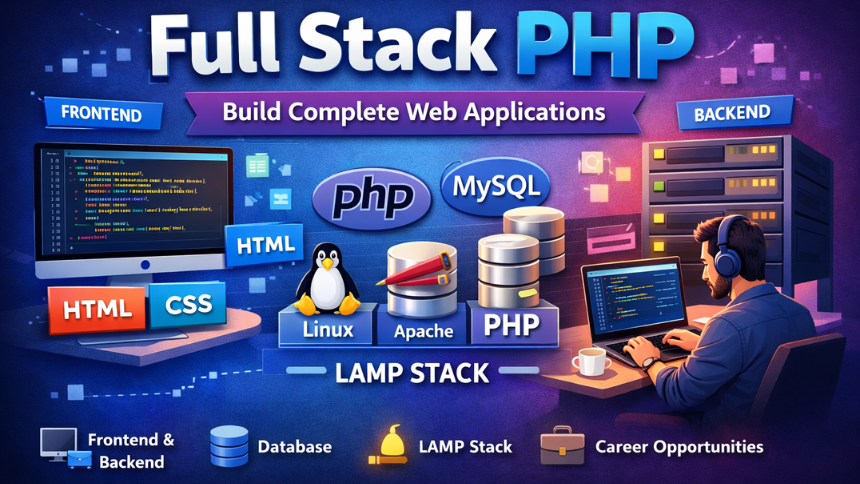
One of the most common environments for Hypertext Preprocessor development is the LAMP stack. LAMP stands for:
- Linux – operating gadget
2. Apache – web server
3. MySQL – database
4. Hypertext Preprocessor – server-side language This stack offers the whole thing required to expand and host dynamic web packages.
Popular Hypertext Preprocessor frameworks
Modern-day Hypertext Preprocessor improvement regularly makes use of frameworks to hurry up improvement and improve code shape.
Laravel
Laravel is the most popular Hypertext Preprocessor framework these days. It offers:
4. MVC structure
5. built-in authentication
6. RESTful routing
7. ORM (Eloquent)
8. Safety features Laravel simplifies complicated obligations and is broadly used for employer-stage packages.
CodeIgniter
CodeIgniter is lightweight and easy to analyze. it is appropriate for small to medium-sized initiatives.
Symfony
Symfony is a powerful and flexible framework utilized in big-scale packages. Using frameworks improves productiveness, maintainability, and scalability.
abilities Required to emerge as a full-stack Hypertext Preprocessor developer
To emerge as a hit full-stack Hypertext Preprocessor developer, you want:
1. robust understanding of HTML, CSS, and JavaScript
2. Middle Hypertext Preprocessor expertise
3. Database design and SQL abilities
4. Expertise of MVC structure
5. Primary understanding of APIs and REST
6. version manipulate (Git)
Benefits of full-stack Hypertext Preprocessor
1.Value-powerful improvement Hypertext Preprocessor is open-source and free. Website hosting environments for Hypertext Preprocessor are low-priced and broadly available.
2.Big Network Guide Hypertext Preprocessor has been around for decades. It has a huge network, documentation, and resources.
3.Flexibility Hypertext Preprocessor integrates without problems with databases, CMS structures (like WordPress), and third-party services.
actual-global packages of full stack Hypertext Preprocessor
- E-commerce website
2. weblog structures
3. CRM systems
4. admin dashboards
5. reserving systems
6. sentence management systems
7. gaining knowledge of management systems Even big structures to start with began with Hypertext Preprocessor-based systems.
career possibilities
Full Stack Hypertext Preprocessor builders can work as:
1. Web Developer
2. Backend Developer
3. Hypertext Preprocessor Developer
4. Laravel Developer
5. Freelance Developer
gaining knowledge of Roadmap
for Full Stack Hypertext PreprocessorIn case you want to begin gaining knowledge of Full Stack Hypertext Preprocessor, comply with this roadmap:
1. Analyze HTML & CSS, apprehend webpage shape and styling.
2. Analyze JavaScript fundamentals, upload interactivity and DOM manipulation.
3. Analyze middle Hypertext Preprocessor, apprehend variables, loops, capabilities, arrays, bureaucracy.
4. Analyze MySQL practice CRUD operations. Step
5. join Hypertext Preprocessor with Database, build small initiatives like login systems.
6. Analyze a framework (Laravel encouraged), apprehend MVC sample and routing.
Build initiatives Create actual-global packages like:
1. weblog website
2. e-commerce mini undertaking
3. admin panel
4. REST API Realistic initiatives are crucial for learning Hypertext Preprocessor improvement.
demanding situations
1. Negative code shape without frameworks
2. Overall performance issues with unoptimized queries but these demanding situations may be solved through gaining knowledge of pleasant practices and modern-day frameworks.