





About This Course
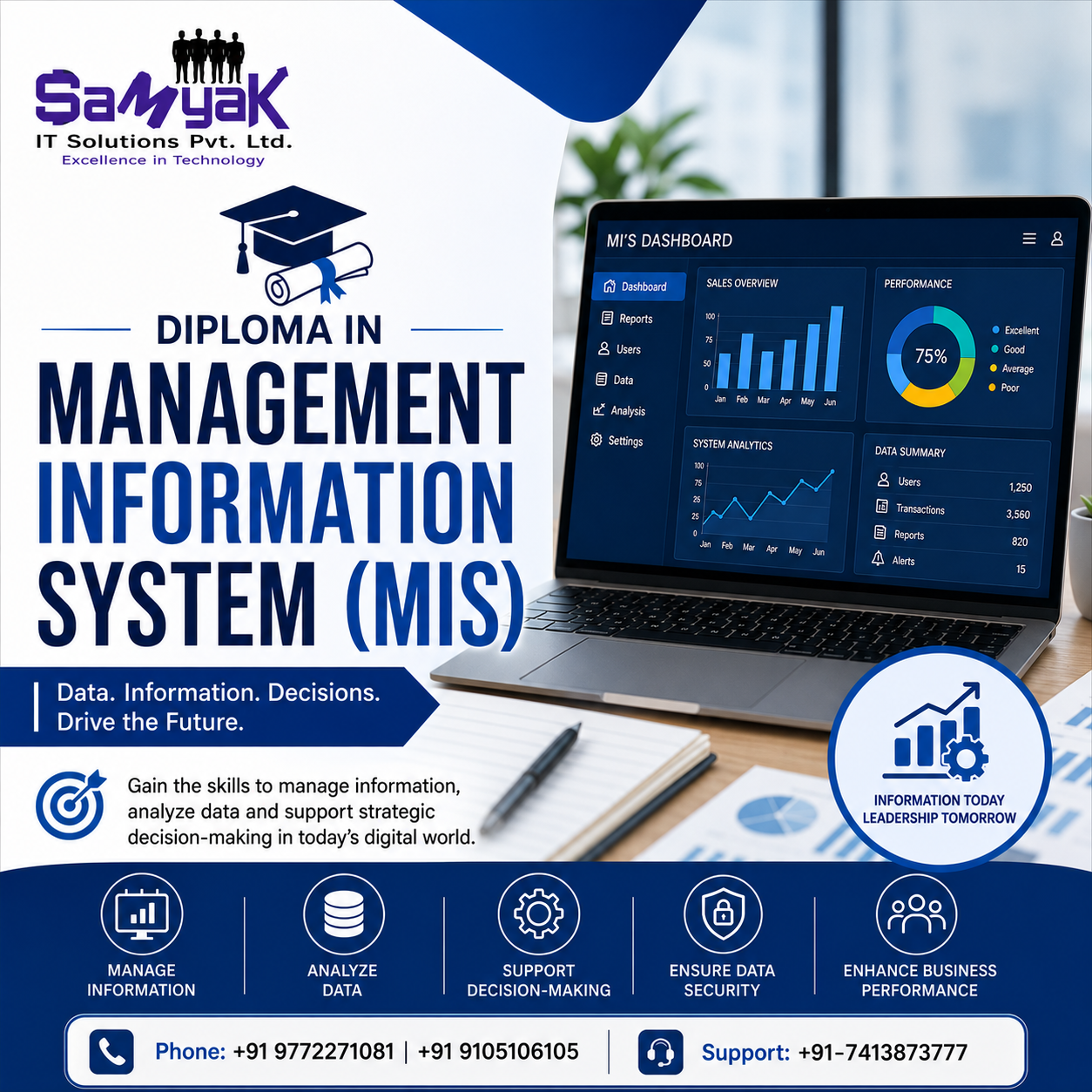
The MIS Diploma is a professional career-oriented program designed for students, graduates, job seekers, office professionals, and business executives who want to develop expertise in Management Information Systems, business reporting, data analysis, and decision-making. In today's digital business environment, organizations rely heavily on accurate data, business intelligence, and automated reporting systems to make strategic decisions. A MIS Diploma equips learners with the technical and analytical skills required to manage business information efficiently and support organizational growth.
The MIS Diploma focuses on transforming raw business data into meaningful reports that help companies monitor performance, improve productivity, and make informed decisions. Businesses across industries—including IT, banking, finance, manufacturing, healthcare, retail, logistics, education, and e-commerce—require professionals with strong Management Information System skills. Completing a MIS Diploma significantly improves employability because MIS professionals play a critical role in managing business information and reporting systems.
One of the biggest advantages of pursuing a MIS Diploma is that it combines data management, spreadsheet automation, reporting, business analytics, and database management into one comprehensive course. Instead of learning separate tools individually, students receive structured training that prepares them for real-world corporate environments where data-driven decision-making is essential.
The MIS Diploma begins with the fundamentals of Management Information Systems. Students understand how organizations collect, organize, process, store, and analyze business data. They learn how management information supports planning, operations, performance monitoring, and strategic decision-making across different departments.
Microsoft Excel is one of the most important software applications covered in the MIS Diploma. Students receive advanced practical training in formulas, functions, Pivot Tables, Pivot Charts, conditional formatting, lookup functions, dashboards, automation techniques, and data visualization. Since Excel remains one of the most widely used business reporting tools, mastering Excel greatly enhances the value of the MIS Diploma.
Business reporting is another core component of the MIS Diploma. Students learn how to prepare daily reports, weekly reports, monthly MIS reports, KPI dashboards, sales reports, inventory reports, financial summaries, and operational performance reports. Organizations rely on these reports to evaluate business performance and identify improvement opportunities.

The MIS Diploma also includes Microsoft Power BI, allowing students to build interactive dashboards, visualize business data, and generate dynamic reports. Business Intelligence tools have become increasingly important because companies require real-time insights for faster and more accurate decision-making.
Database management forms another important part of the MIS Diploma. Students learn Microsoft Access and SQL basics to understand how business information is stored, retrieved, filtered, and managed efficiently. Database knowledge helps MIS professionals work with structured information and large datasets.
Google Sheets is also introduced in the MIS Diploma, enabling learners to work with cloud-based spreadsheets, collaborate with teams remotely, automate workflows, and share reports in real time. Cloud collaboration skills are becoming increasingly valuable as organizations adopt digital workplace solutions.
Practical business analysis is one of the strongest features of the MIS Diploma. Students work on real business datasets involving sales analysis, customer reporting, inventory tracking, employee performance monitoring, production reports, and financial summaries. These practical projects prepare learners for actual corporate responsibilities.

The MIS Diploma also focuses on data accuracy, report validation, data cleaning, and business documentation. Students understand how to organize information correctly, eliminate errors, and prepare professional reports that management can rely upon for decision-making.
One of the major advantages of completing a MIS Diploma is the broad range of career opportunities available across industries. Graduates can work as MIS Executives, MIS Analysts, Data Analysts, Reporting Executives, Business Operations Executives, Management Information Executives, and Business Intelligence Support Professionals. Since nearly every medium and large organization uses MIS reporting, demand for skilled professionals remains consistently high.
The MIS Diploma is particularly valuable for job seekers because many companies specifically recruit candidates with strong Excel and MIS reporting skills. Employers prefer individuals who can independently manage reports, analyze business data, automate repetitive tasks, and support management with accurate information.
Working professionals can also benefit greatly from the MIS Diploma. Employees in sales, finance, HR, operations, logistics, customer support, and administration can improve their reporting skills, increase productivity, and qualify for promotions by mastering Management Information Systems.
Business owners and entrepreneurs can use the knowledge gained through the MIS Diploma to monitor business performance, analyze sales trends, track inventory, manage customer data, and prepare business dashboards. Better information leads to better business decisions and improved profitability.
The MIS Diploma also develops analytical thinking and problem-solving abilities. Students learn how to interpret business data, identify trends, measure performance indicators, and recommend improvements based on factual information rather than assumptions.
Another important advantage of the MIS Diploma is that it provides an excellent foundation for advanced careers in Business Intelligence, Data Analytics, Financial Analysis, ERP Systems, SQL Development, Power BI Development, and Data Science. The reporting and analytical skills learned during the course remain valuable throughout a professional career.
Freelancing opportunities are also available after completing the MIS Diploma. Many organizations outsource dashboard creation, Excel automation, business reporting, Power BI development, and data analysis projects. Professionals with MIS expertise can provide these services independently to businesses around the world.
The MIS Diploma is suitable for commerce students, management students, graduates, MBA aspirants, office executives, working professionals, entrepreneurs, and job seekers who want to build careers in business reporting and analytics. Since the course begins with the fundamentals and progresses toward advanced reporting techniques, learners from different educational backgrounds can successfully complete the program.
As organizations continue adopting digital transformation, the importance of business data and reporting continues to increase. Companies need professionals who can convert raw data into meaningful insights that support strategic decision-making. Completing a MIS Diploma prepares learners to meet these evolving industry requirements.
If you want to build expertise in business reporting, Excel automation, dashboards, analytics, and management information systems, then enrolling in a MIS Diploma is an excellent career decision. The course offers practical learning, industry-relevant skills, strong job opportunities, and long-term career growth in business analytics and information management.
This MIS Diploma is designed to prepare students for modern corporate environments by combining advanced Excel, Power BI, database management, reporting automation, data visualization, and business analytics. Whether your goal is to become an MIS Executive, Data Analyst, Reporting Specialist, or Business Intelligence professional, the MIS Diploma provides the practical knowledge, technical skills, and professional confidence needed for long-term success in today's data-driven business world.