





About This Course
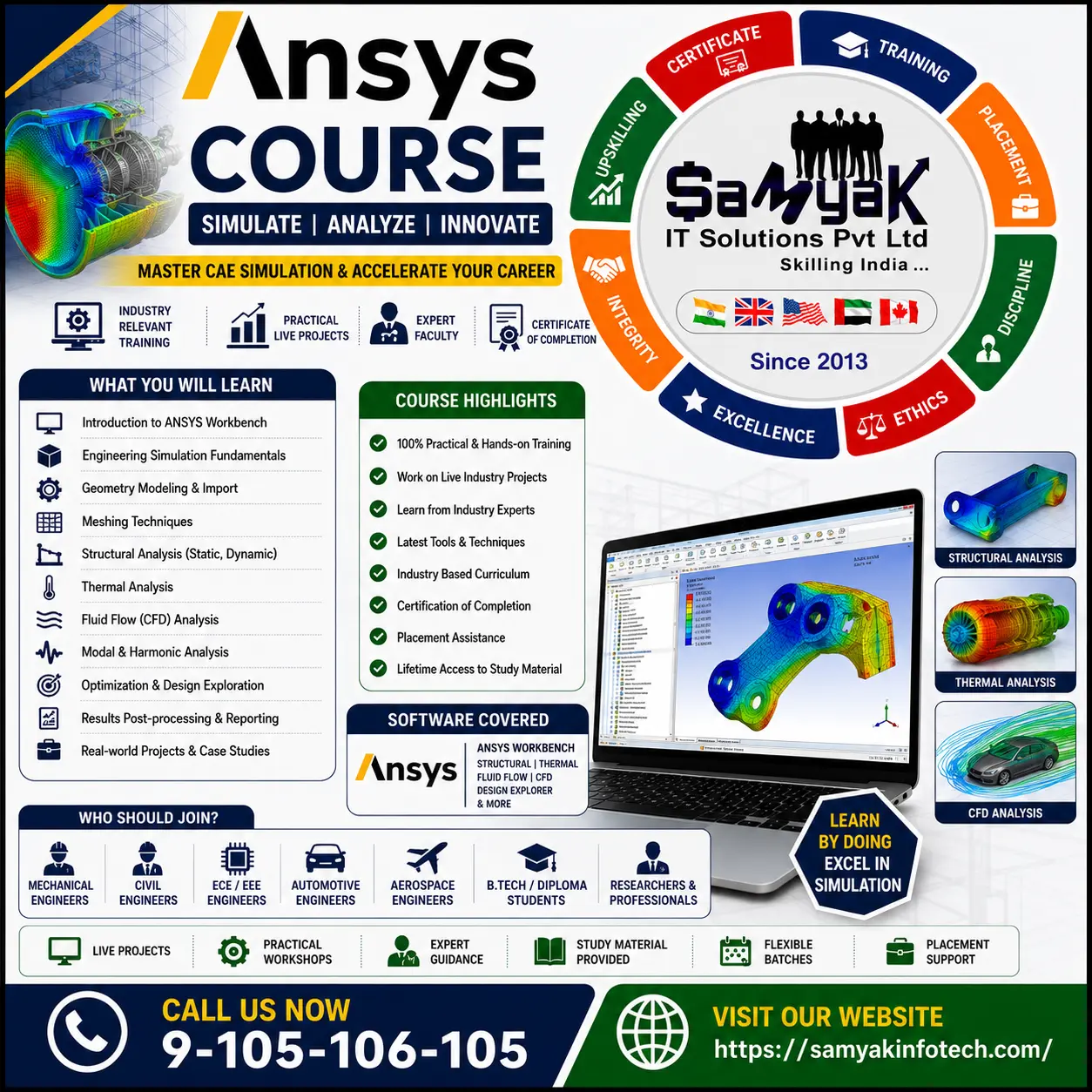
The Ansys Course is a comprehensive professional training program designed for mechanical engineering students, civil engineers, aerospace engineers, automotive professionals, design engineers, CAE engineers, and graduates who want to build expertise in engineering simulation and computer-aided engineering (CAE). Ansys is one of the world's leading engineering simulation software platforms used to analyze product performance, optimize designs, and solve complex engineering problems before manufacturing. This Ansys course provides practical training in finite element analysis (FEA), structural analysis, computational fluid dynamics (CFD), thermal analysis, and simulation techniques used across modern engineering industries.

The demand for professionals skilled in Ansys continues to grow because organizations increasingly rely on simulation technology to reduce development costs, improve product quality, shorten design cycles, and enhance engineering performance. Automotive companies, aerospace manufacturers, defense organizations, energy companies, construction firms, electronics manufacturers, and research organizations actively recruit engineers with practical Ansys expertise.
One of the biggest advantages of enrolling in an Ansys course is its project-oriented learning methodology. Instead of focusing only on theoretical engineering concepts, students perform real engineering simulations using industry-standard software. Practical exposure helps learners understand engineering behavior, validate product designs, and make informed engineering decisions before physical production.
The Ansys course begins with an introduction to engineering simulation, CAE fundamentals, and the ANSYS Workbench interface. Students learn software navigation, project setup, geometry import, material selection, engineering units, coordinate systems, and simulation workflow. These foundational concepts prepare learners for advanced engineering analysis.
Finite Element Analysis (FEA) is one of the most important modules included in the Ansys course. Students learn mesh generation, boundary conditions, loading methods, stress analysis, deformation analysis, strain calculations, factor of safety evaluation, and structural validation. FEA helps engineers predict structural behavior under different operating conditions.
Structural analysis forms another major component of the Ansys course. Students perform static structural analysis, modal analysis, harmonic analysis, transient structural analysis, fatigue analysis, and buckling analysis. These simulations help engineers design safe and reliable mechanical components and civil structures.

The Ansys course also covers Computational Fluid Dynamics (CFD) using ANSYS Fluent. Students learn fluid flow analysis, heat transfer, turbulence modeling, pressure distribution, airflow simulation, pipe flow analysis, thermal management, and cooling system design. CFD simulations are widely used in automotive, aerospace, HVAC, manufacturing, and energy industries.
Thermal analysis is another important topic included in the Ansys course. Students understand steady-state thermal analysis, transient thermal analysis, heat conduction, convection, radiation, thermal stress, and temperature distribution. These practical skills are essential for product development and industrial applications.
Geometry preparation and model simplification are covered using SpaceClaim and DesignModeler during the Ansys course. Students learn geometry creation, editing, defeaturing, repair, parameterization, and CAD model preparation before simulation. Efficient geometry preparation significantly improves simulation accuracy and performance.
One of the strongest features of the Ansys course is its live project-based learning approach. Students perform simulations on machine components, pressure vessels, gears, shafts, bridges, brackets, piping systems, heat exchangers, automotive parts, aerospace structures, and industrial equipment. These practical projects help learners gain real-world engineering experience.
The Ansys course also teaches advanced meshing techniques, contact definitions, nonlinear analysis, optimization methods, solver settings, convergence criteria, and post-processing tools. Students learn to interpret simulation results accurately and prepare professional engineering reports.
Engineering validation and design optimization are important aspects of the Ansys course. Students compare multiple design alternatives, optimize product performance, reduce material usage, improve structural efficiency, and increase product reliability using simulation-driven engineering.
Completing the Ansys course opens outstanding career opportunities across multiple engineering industries. Graduates can work as CAE Engineers, Simulation Engineers, Design Engineers, FEA Analysts, Product Development Engineers, R&D Engineers, Structural Analysts, and CFD Engineers.
The Ansys course is highly valuable for mechanical engineers, civil engineers, aerospace engineers, automotive engineers, manufacturing professionals, and research engineers who want to build specialized careers in engineering simulation and product development. Simulation skills significantly improve employability and salary potential.
Working professionals can also benefit from the Ansys course by upgrading their engineering analysis capabilities and qualifying for senior design, simulation, and research positions. Companies increasingly prefer engineers who can validate product designs using advanced simulation software before manufacturing.
Another major advantage of the Ansys course is that it provides a strong foundation for advanced engineering technologies such as topology optimization, multiphysics simulation, digital twins, computational mechanics, and high-performance engineering analysis. These advanced skills expand career opportunities in global engineering organizations.
Freelancing and consulting opportunities are also available after completing the Ansys course. Professionals can provide engineering simulation, structural analysis, CFD analysis, product optimization, design validation, and engineering consulting services to manufacturing companies, startups, and research organizations worldwide.
The Ansys course is suitable for engineering students, diploma holders, graduates, design engineers, product development professionals, and anyone interested in engineering simulation. Since the curriculum starts with simulation fundamentals before progressing toward advanced engineering analysis, learners from different technical backgrounds can complete the program successfully.
As industries continue investing in product innovation, digital engineering, smart manufacturing, electric vehicles, renewable energy, aerospace technology, and industrial automation, the demand for professionals skilled in Ansys continues increasing. Organizations require experts who can improve product quality, reduce development costs, and accelerate engineering innovation through advanced simulation.
If you want to build a successful career in engineering simulation, product design, structural analysis, research and development, or computer-aided engineering, enrolling in an Ansys Course is an excellent career decision. The course provides practical simulation expertise, industry-recognized software skills, live engineering projects, and outstanding career opportunities.
This Ansys Course is designed to prepare learners for modern engineering careers through comprehensive training in finite element analysis, computational fluid dynamics, thermal analysis, structural simulation, engineering optimization, product validation, ANSYS Workbench, and real-world engineering projects. Whether your goal is to become a CAE Engineer, Simulation Engineer, FEA Analyst, Design Engineer, or Product Development Specialist, mastering Ansys provides the technical expertise, analytical knowledge, and professional confidence required for long-term success in today's global engineering industry.