📞 +91-7413825777 | +91-9105106105 | +91-7413873777
FB X IG YT

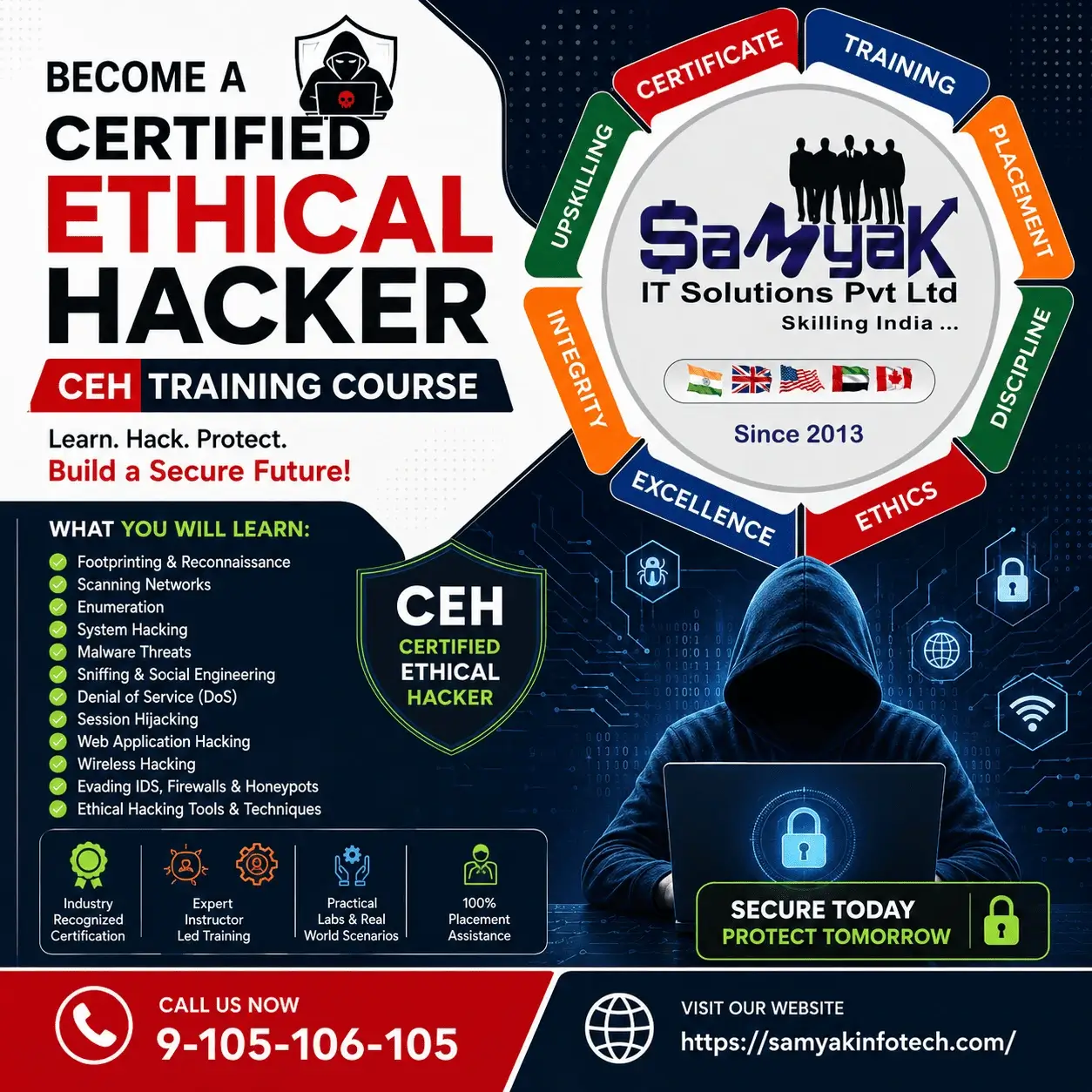
Certified Ethical Hacking (CEH) Training Course

Master ethical hacking, penetration testing, and cybersecurity tools to identify vulnerabilities and secure networks like a certified cybersecurity professional.

Course Overview

  • Next Batch Next Batch:New batch starts every 7 days. Early registration is recommended.
  • Course Duration Course Duration:2 – 2.5 Months (Including Hands-on Labs and Certification Guidance)
  • Eligibility Eligibility:
    • Graduates
    • IT Professionals
    • Network Engineers
    • anyone looking to pursue a career in Information Security.
  • Tools Tools:
      5
  • Modes of Training Modes of Training:Online Classes/Offline Training (at selected centers)
  • Projects Projects:Available
CTC

₹12 LPA+

Average CTC

Students

28000+

Naukri, LinkedIn, Glassdoor

Mentors

3+

Industry Mentors

Join Our 100% Job Assistance

Certified Ethical Hacking (CEH) Training Course

  • Learn ethical hacking fundamentals and cybersecurity principles.
  • Understand network security, footprinting, and reconnaissance techniques.
  • Master vulnerability assessment and penetration testing methodologies.
  • Work on real-world hacking simulations and system exploits.
  • Study malware, phishing, and social engineering defense techniques.
  • Earn your Certified Ethical Hacking (CEH) Certification recognized globally by EC-Council.

Overview of Certified Ethical Hacking (CEH) Training Course

The Certified Ethical Hacking (CEH) Training Course is a globally accredited cybersecurity certification by EC-Council, designed to teach students how to think and act like hackers — but ethically. It provides deep knowledge of security threats, system vulnerabilities, and network defense strategies, providing you with the specialized technical expertise needed to advance your career.

Learners will gain practical experience using industry-standard hacking tools and techniques on controlled labs and virtual environments. By the end of this course, you’ll earn your CEH Certification, qualifying you for roles like Ethical Hacker, Security Analyst, or Penetration Tester in top IT and cybersecurity firms.

What You’ll Learn From Course

Understand cybersecurity threats, attacks, and defense mechanisms.
Perform network scanning, footprinting, and reconnaissance.
Execute penetration tests and identify security vulnerabilities.
Analyze and defend against malware, phishing, and social engineering attacks.
Use professional hacking tools like Metasploit, Nmap, and Wireshark.
Earn your CEH Certification and launch a global cybersecurity career.

Who Should Take this Course

Undergraduates
Graduates
Job Seekers
School Students (10th and above)
IT Professionals
Networking Students

Job Roles For Course

Ethical Hacker
Cyber Security Analyst
Penetration Tester
Security Consultant
Network Security Engineer
Information Security Analyst

Tools Covered In Course

Kali Linux
Wireshark
Nmap
Metasploit Framework
Burp Suite
John the Ripper

What's included ?

Live Project

Theory doesn’t help anyone in professional life, professional Courses are better learnt by experimenting.

Global Certificates

Certifications like Microsoft, Google, HP, Cisco, EC-Council make a huge difference in placement.

Advanced Contents

Contents are based upon the latest trends in IT industry nd as per the recommendations of IT Guys.

Multi Location

Good opportunities need to spread geographically, so is Samyak for the benefit of professional and job seekers.

Job Oriented

All courses are as per industry needs and with projects/ examples, which make Samyak’s approach job oriented.

Placement Assistance

Once the course is completed from Samyak, there is a dedicated team to guide for interview and placements.

Certified Ethical Hacking (CEH) Training Course Syllabus

1. Ethical Hacking – Fundamentals & Cyber Law (2.5 Months)

  • Networking Concepts – How Internet works, Network, IP types, Domain Name, Electronic Mail, architecture, message formats, ports, and browsers.
  • Cyber Security Overview – Cybercrime scenarios, hacking vs ethical hacking, hacker profiles, types/classes of hackers, and security challenges.
  • Overview of Cyber Law – Introduction to Cyber Law, Indian Cyber Laws, IT ACT 2000 & 2008, internet frauds, and cyber law cases in India.

2. Core Hacking Methodologies & Windows Security

  • Computer Virtualization & LAB Setup – Virtualization technology concepts, creating virtual machines, and installing Windows/Linux OS.
  • Information Gathering (Footprinting) – Methods using websites/software, smart search engines, Ping, Whois, People Search, and DNS lookup.
  • Windows Hacking & Security – User accounts security, changing passwords, elevating privileges, and bypassing/finding Windows passwords.
  • Advanced Techniques – Data Recovery, Steganography & Cryptography, Desktop exploitation, Fake Calling, and SMS.
  • Mobile Phone Hacking – Use of mobile in hacking, hidden functions, rooting, and password cracking.

3. Attacks, Malware & Threat Protection

  • Denial of Service Attack (DOS-Attack) – What is a DoS/DDoS attack, attack techniques, and detailed study on DoS tools.
  • Hacking by Viruses, Trojans, Keyloggers & Spywares – Trojan/virus attacks, system entry methods, and bypassing antivirus software.
  • Proxy Server & VPN Technology – Proxies vs VPNs, hiding IP address while chatting, converting machines to proxy servers, and proxy logs.
  • Google Hacking & Google Hacking Database – Search engine architecture, hacking search engines, and finding admin pages/weaknesses.
  • Email & Social Sites Hacking – Analysis of email attacks (live demo), session hijacking, cookies stealing, phishing, and Facebook security.

4. Advanced Exploitation, Linux & Cyber Investigation

  • SQL Injection – Web application mechanics, SQL injection detection, attack execution, and defending web applications.
  • Wireless Hacking – Wireless standards, common vulnerabilities, encryption standards (Wi-Fi, WEP, WPA/WPA2, WPS cracking).
  • Linux Training – Use of Linux, Wi-Fi cracking, pentesting (site cloning), cookies grabbing, network discovery, and server hacking.
  • System Security – Facebook/mail account security, WhatsApp security, and Android phone security features.
  • Cyber Crime Investigation (Case Study) – Cybercrime types, email tracing, header analysis, phishing cases, data theft, and impersonation cases.

5. Linux Administration (1.5 Months)

  • Introduction to open source technology & features of Linux
  • Installation of Linux operating system
  • Understanding of file systems with graphical & CLI
  • Learn some basic commands & some bash tricks

Key Features

  • Advanced Syllabus
  • Certified Faculties
  • Live Projects Based
  • International Certifications Included
  • EC - Council Ethical Hacking Associate (EHA) Curriculum

Job Roles

  • Ethical Hacker
  • Cyber Security Analyst
  • Information Security Officer
  • Network Security Engineer
  • Penetration Tester

Program Highlights

  • Master complete ethical hacking workflows, from networking fundamentals to advanced exploitation like SQL injection and wireless tracking.
  • Gain practical command - line experience with dedicated modules in system virtualization, Windows security, and Linux administration.
  • Align your training with elite industry credentials, covering standard global methodologies and official EC - Council curriculum concepts.
  • Study real - world operational security protocols, including cyber laws, data recovery mechanisms, and practical case studies.

What is an Ultimate Career Choice?

Massive Market
Massive Market

Learn skills that open doors to vast, growing markets worldwide, constantly increasing demand across industries.

High-Paying Jobs
High-Paying Jobs

Acquire in-demand expertise to command top salaries, and accelerate long-term financial growth .

Future-Proof Career
Future-Proof Career

Build adaptable, technology that keep your career relevant, and valuable in changing times.

Entrepreneurial Path

Gain practical tools, mindset and networks needed to launch ventures, create sustainable businesses.

Global Impact
Global Impact

Develop solutions and leadership that solve real-world problems, positively impacting communities.

Large Community
Large Community

Join a diverse, supportive community of learners, mentorship, opportunities, and lasting connections.

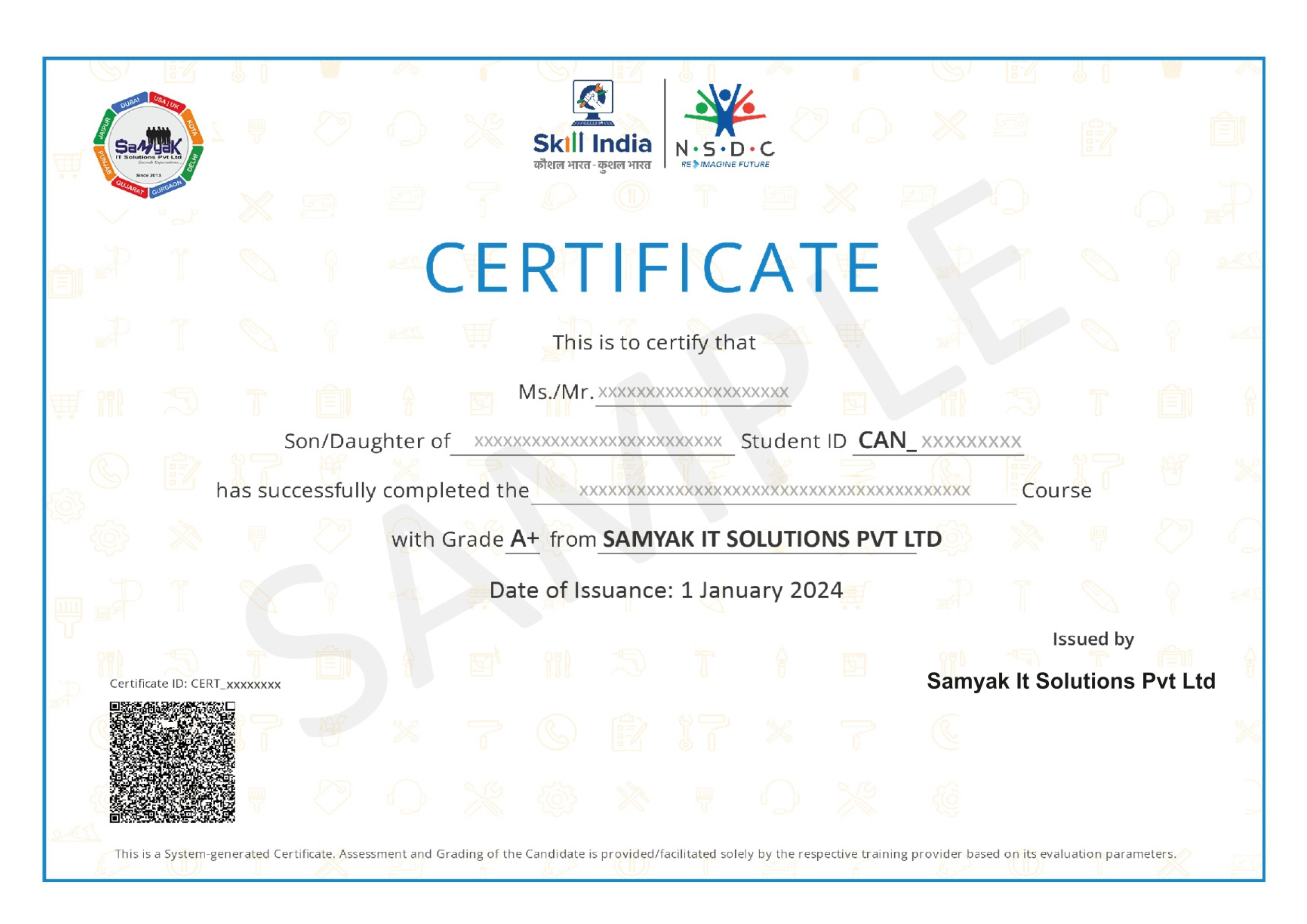
Be in the spotlight by getting certified!

A detailed overview of the course, including key topics, objectives, and module sequence.

Samyak Certificate (included)

Samyak Certificate (included)

ISO 9001:2008 certified training recognized globally.

NSDC Certificate (included)

NSDC Certificate (included)

Govt of India-backed certification enhancing employability.

Get Certified
Certified Ethical Hacking

About This Course

The Certified Ethical Hacking course is one of the most in-demand cyber security training programs for students and professionals who want to build a successful career in the cyber security industry. As businesses, organizations, banks, governments, and digital platforms continue moving online, the demand for cyber security experts is increasing rapidly across the world. Companies now require skilled ethical hackers who can identify security vulnerabilities, protect systems, and prevent cyber attacks before hackers can exploit weaknesses. This Certified Ethical Hacking course is specially designed to help students learn practical cyber security skills, ethical hacking techniques, penetration testing methods, and security analysis concepts used in real-world environments.

The Certified Ethical Hacking course focuses on practical learning and industry-level cyber security training. Students learn how ethical hackers identify vulnerabilities in networks, applications, websites, systems, and servers. Unlike malicious hackers, ethical hackers work legally and professionally to improve cyber security by testing system defenses and helping organizations secure their digital infrastructure. This Certified Ethical Hacking course teaches students how to think like ethical hackers while following legal and professional cyber security standards.

Cyber security has become one of the fastest-growing industries globally because cyber attacks, ransomware threats, phishing attacks, data breaches, and online fraud continue increasing every year. Businesses now invest heavily in cyber security solutions to protect sensitive information and maintain customer trust. Because of this growing industry demand, professionals with Certified Ethical Hacking skills are highly valued in IT companies, government organizations, banking sectors, healthcare industries, cloud service providers, e-commerce companies, and multinational corporations.

The Certified Ethical Hacking course starts with the fundamentals of cyber security, networking, Linux systems, and information security concepts. Students gradually learn advanced topics such as penetration testing, vulnerability assessment, password cracking, malware analysis, web application security, wireless network security, footprinting, scanning techniques, system hacking, social engineering, and network defense mechanisms. The course structure is designed to help students understand both theoretical concepts and practical implementation techniques.

One of the biggest advantages of joining a Certified Ethical Hacking course is the practical exposure to professional cyber security tools and technologies. Students learn how to use tools like Kali Linux, Wireshark, Nmap, Metasploit Framework, Burp Suite, SQLmap, Aircrack-ng, Hydra, Nessus, and many other industry-standard tools used by ethical hackers and cyber security professionals worldwide. Hands-on practice with these tools helps students understand real-world attack simulations and defense strategies.

The Certified Ethical Hacking course also teaches students about network security and how hackers attempt to exploit vulnerabilities in systems. Students learn how to scan networks, analyze traffic, identify open ports, test security configurations, and monitor suspicious activities. Understanding network behavior and attack methods is extremely important for cyber security professionals because organizations rely on secure networks for business operations and data protection.

Web application security is another important area covered in the Certified Ethical Hacking course. Many cyber attacks target websites and web applications because they often store sensitive customer and business data. Students learn how to identify vulnerabilities such as SQL Injection, Cross-Site Scripting (XSS), broken authentication, insecure APIs, and misconfigured servers. These skills are highly valuable because web application security testing is one of the most demanded areas in cyber security.

The Certified Ethical Hacking course also focuses on password security, encryption techniques, authentication systems, and access control methods. Students learn how weak passwords can be exploited and how organizations implement security measures to protect sensitive data. Understanding password security and encryption concepts is essential for preventing unauthorized access and securing digital systems.

Another major advantage of the Certified Ethical Hacking course is the wide range of career opportunities available in the cyber security industry. After completing this course, students can work as Ethical Hackers, Cyber Security Analysts, Penetration Testers, Security Consultants, SOC Analysts, Information Security Analysts, and Vulnerability Assessment Experts. The cyber security industry offers high salary packages, international career opportunities, remote work flexibility, and long-term professional growth.

The Certified Ethical Hacking course is also highly beneficial for students interested in bug bounty programs and freelance cyber security work. Many organizations reward ethical hackers for identifying security vulnerabilities in their systems. Skilled professionals can participate in bug bounty platforms and earn rewards by responsibly reporting vulnerabilities to companies.

Cyber security professionals are responsible for protecting businesses from financial losses, reputation damage, and legal issues caused by cyber attacks. This makes cyber security one of the most respected and critical professions in the technology industry. Companies prefer hiring professionals who understand ethical hacking techniques because proactive security testing helps reduce cyber risks significantly.

The Certified Ethical Hacking course also introduces students to digital forensics and incident response concepts. Students learn how security professionals investigate cyber attacks, analyze suspicious activities, collect digital evidence, and respond to security incidents. Incident response is an important part of cyber security because organizations must react quickly when security breaches occur.

The growing use of cloud computing, IoT devices, mobile applications, artificial intelligence, and online services has increased the need for advanced cyber security solutions. As technology continues evolving, organizations need skilled professionals who can secure modern digital infrastructures and protect critical systems from cyber threats. This creates long-term demand for professionals trained in Certified Ethical Hacking.

This Certified Ethical Hacking course is suitable for beginners, IT students, networking professionals, system administrators, software developers, and anyone interested in cyber security. Even students without prior cyber security experience can learn ethical hacking concepts because the course starts with basic networking and security fundamentals before moving to advanced topics.

Practical learning is one of the strongest parts of the Certified Ethical Hacking course. Students perform security testing in controlled environments and work on real-world cyber security scenarios to improve their technical skills. Hands-on practice helps students understand how attacks happen and how security measures can prevent vulnerabilities effectively.

The Certified Ethical Hacking course also improves analytical thinking, technical problem-solving, and security awareness. Cyber security professionals must think critically and analyze systems carefully to identify security weaknesses. This course helps students develop these important professional skills through practical exercises and real cyber security examples.

As organizations continue facing increasing cyber threats, the demand for ethical hackers and cyber security professionals will continue growing in the future. Cyber security is considered one of the most stable and high-growth career fields in the IT industry. Students who complete a Certified Ethical Hacking course gain valuable technical knowledge and practical skills that can help them build successful careers in cyber security and information security domains.

If you are passionate about technology, security, ethical hacking, and protecting digital systems, then joining a Certified Ethical Hacking course can be an excellent career decision. The field offers strong job demand, high salary potential, professional recognition, and exciting opportunities to work on advanced technologies and security systems.

This Certified Ethical Hacking course is designed to make students industry-ready by combining cyber security fundamentals, ethical hacking techniques, practical penetration testing, security analysis, and real-world cyber defense strategies. Whether your goal is to become an ethical hacker, cyber security analyst, penetration tester, or information security professional, this course provides the right foundation for long-term career success in the cyber security industry.


Exclusive Career Support Programs at Samyak Computer Classes

At Samyak Computer Classes, we don’t just teach courses — we help students build successful careers. Along with professional training, we provide FREE Career Development & Placement Support Programs to make every student industry-ready.

Free Personality Development Sessions

Conducted Every Saturday

Build the confidence required to succeed in today’s professional world through our weekly FREE Personality Development Sessions.

  • Communication Skills Improvement
  • Confidence & Public Speaking
  • Interview Communication
  • Professional Grooming
  • Corporate Etiquette

Free Placement Readiness Program

Conducted Every Second Saturday

Our specialized Placement Readiness Sessions are designed to prepare students for real-world job opportunities.

📄 Resume Preparation

Learn how to create a professional and recruiter-friendly resume.

🌐 Online Job Portal Awareness

Guidance on using online job platforms effectively to find better opportunities.

🎯 Mock Interview Sessions

Practice real interview scenarios with expert feedback.

Free Placement Drive

Conducted Every Third Saturday

Samyak organizes FREE Placement Drives exclusively for Samyak students to connect them with hiring companies.

  • Direct Interview Opportunities
  • Industry Exposure
  • Career Guidance & Support
  • Better Job Opportunities
  • Professional Networking

Our Students Placed In Top Companies

×

Application Form