About This Course
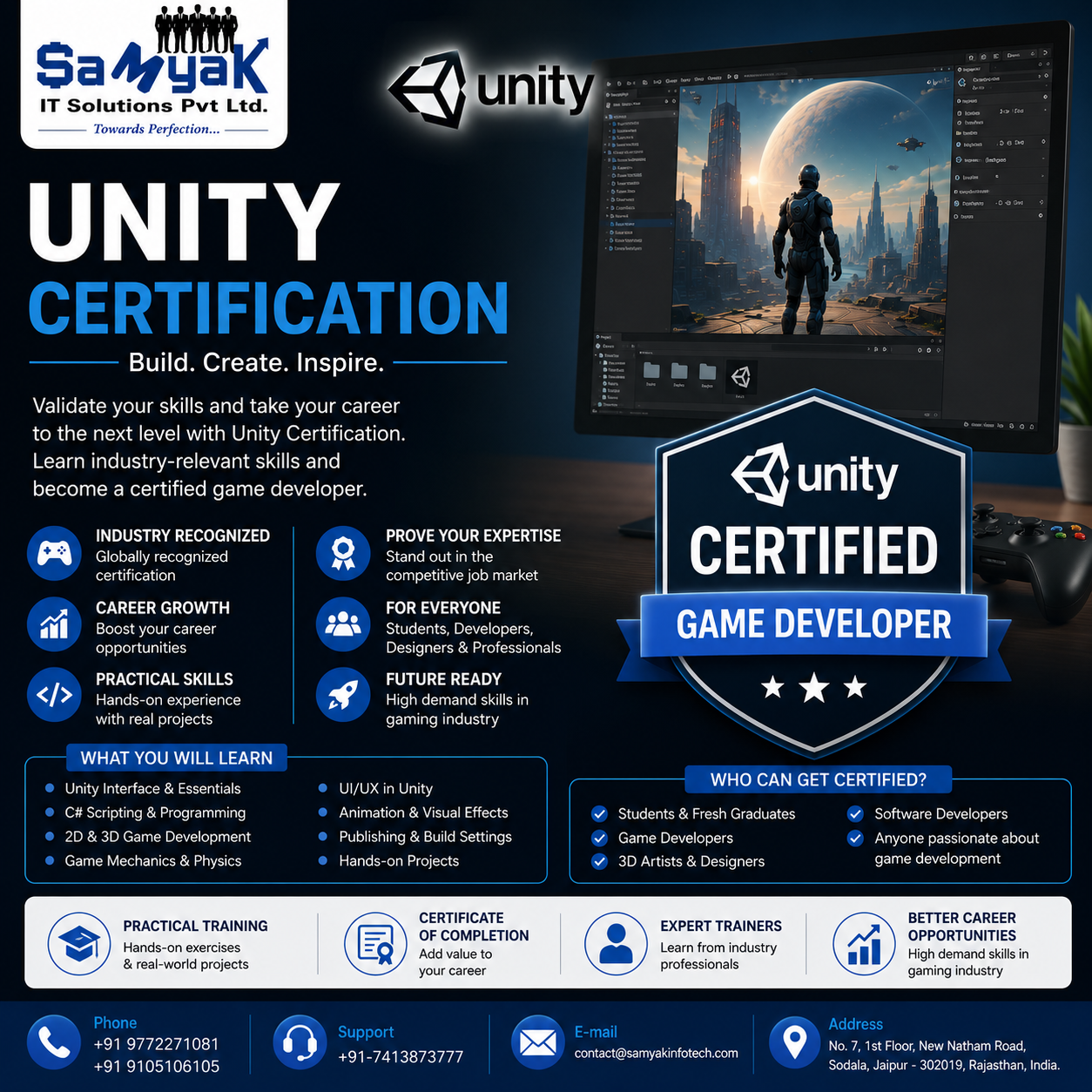
The Unity Certification Course is one of the most advanced and career-focused training programs for students and professionals who want to build successful careers in game development, AR/VR technologies, interactive applications, and digital simulation industries. The gaming and immersive technology industry is growing rapidly worldwide, and companies continuously require skilled Unity developers who can create professional games, augmented reality applications, virtual reality experiences, and interactive digital products. This Unity Certification Course is specially designed to help students gain practical game development skills and become industry-ready Unity professionals.
The Unity Certification Course focuses on practical learning, real-world project development, and modern game creation techniques. Students learn how to design, develop, test, and publish games and interactive applications using the Unity game engine. Unity is one of the most widely used game development platforms globally because it supports mobile games, PC games, console games, AR applications, VR experiences, simulations, and metaverse development.
The gaming industry has become one of the fastest-growing entertainment and technology sectors in the world. Millions of users play games daily on smartphones, PCs, consoles, and VR devices. Because of this massive industry growth, skilled Unity developers are highly demanded by gaming companies, startups, simulation industries, AR/VR companies, and digital product studios. This Unity Certification Course helps students develop the technical and creative skills required to work professionally in the gaming and interactive technology industry.
The Unity Certification Course starts with the fundamentals of Unity and gradually moves toward advanced game development concepts. Students learn game design principles, scene management, object handling, animations, scripting, physics systems, UI development, audio integration, multiplayer functionality, and performance optimization. The course is designed according to current industry standards and focuses heavily on practical implementation.
One of the biggest advantages of joining the Unity Certification Course is learning C# programming, which is the primary scripting language used in Unity. Students learn how to write scripts for gameplay mechanics, player controls, game logic, animations, AI systems, and interactive features. Programming skills are essential for modern game development, and this course helps students understand coding concepts in a practical and creative environment.
The Unity Certification Course also covers 2D and 3D game development techniques. Students learn how to create game environments, characters, animations, visual effects, gameplay systems, and user interfaces for both 2D and 3D games. Unity supports multiple game genres including action games, racing games, puzzle games, adventure games, simulation games, and educational games.
Augmented Reality (AR) and Virtual Reality (VR) development are important parts of the Unity Certification Course. Modern industries increasingly use AR and VR technologies in gaming, education, healthcare, architecture, real estate, training simulations, and industrial applications. Students learn how to build immersive AR/VR experiences using Unity and AR Foundation technologies.
The Unity Certification Course also focuses on multiplayer game development and networking systems. Students learn how online games work, how players connect in multiplayer environments, and how real-time interactions are managed using networking tools like Photon. Multiplayer gaming is one of the largest segments of the gaming industry, and developers with networking knowledge are highly valued.
Animation and visual effects are additional major topics included in the Unity Certification Course. Students learn how to create smooth character animations, particle effects, transitions, environmental effects, and cinematic gameplay experiences. High-quality visuals and animations improve user engagement and gameplay quality significantly.
Another major advantage of the Unity Certification Course is the wide range of career opportunities available after completing the training. Students can work as Unity Game Developers, AR/VR Developers, Gameplay Programmers, Mobile Game Developers, Simulation Developers, XR Developers, and Interactive Application Developers. The gaming and AR/VR industries offer high salary packages, remote work opportunities, freelancing flexibility, and international career growth.
The Unity Certification Course also supports independent game development and entrepreneurship. Many successful indie game developers use Unity to create and publish their own games on platforms like Google Play Store, Apple App Store, Steam, and gaming consoles. Students who complete the course can develop and monetize their own gaming projects and digital products.
Practical project development is one of the strongest features of the Unity Certification Course. Students work on real game projects, AR/VR applications, simulation systems, and interactive experiences throughout the training. Building live projects helps students improve problem-solving skills, technical confidence, and creative thinking abilities required in professional development environments.
The Unity Certification Course also teaches game optimization techniques because performance is extremely important in game development. Students learn how to improve game speed, reduce lag, optimize graphics, manage memory usage, and create smooth gameplay experiences across different devices.
Game testing and debugging are also important topics covered in the Unity Certification Course. Students learn how to identify bugs, fix gameplay issues, improve user experience, and maintain stable application performance. Debugging skills are essential because game development involves continuous testing and improvement processes.
The Unity Certification Course is suitable for beginners, programmers, creative students, gaming enthusiasts, AR/VR learners, designers, and technology professionals interested in game development and immersive technologies. Even students with no prior game development experience can learn effectively because the course starts with Unity basics and gradually moves toward advanced development techniques.
The course also introduces students to UI/UX concepts in gaming and interactive applications. Good user interfaces improve player experience and make games more engaging. Students learn how to design menus, HUD systems, settings panels, and interactive controls professionally.
Modern industries are increasingly investing in metaverse technologies, immersive simulations, and virtual experiences. Unity plays a major role in these emerging technologies because it supports interactive 3D development and cross-platform deployment. This creates long-term demand for Unity developers and AR/VR professionals.
Freelancing opportunities are also highly available for Unity developers. Businesses and startups regularly hire freelance developers for mobile games, AR experiences, simulation systems, educational apps, and interactive projects. Students who complete the Unity Certification Course can work independently and build global freelance careers.
Portfolio development is another important part of the Unity Certification Course. Students create professional game projects and AR/VR applications during training that can be showcased during interviews, internships, and client meetings. A strong portfolio significantly increases career opportunities in the gaming industry.
If you are passionate about gaming, programming, AR/VR technologies, animation, interactive media, or digital innovation, then joining the Unity Certification Course can be an excellent career choice. The field offers creative freedom, technical growth, strong job demand, international opportunities, and exciting project experiences.
This Unity Certification Course is designed to help students become industry-ready Unity developers by combining practical game development training, C# programming skills, AR/VR knowledge, multiplayer development techniques, animation systems, and real-world project experience. Whether your goal is to work in gaming studios, AR/VR companies, simulation industries, or become an independent game developer, this course provides the right foundation for long-term career success in the gaming and interactive technology industry.






 Placement Statistics
 Next Batch:New batches start every month. Limited seats available – enroll early!
 Course Duration:2 Months including Hands-on Practice (minimum 150 hours of instructional time)
 Eligibility:
 Tools:
 Modes of Training:Online Live Classes/Offline Training (available at all Samyak branches)
 Projects:Available