About This Course
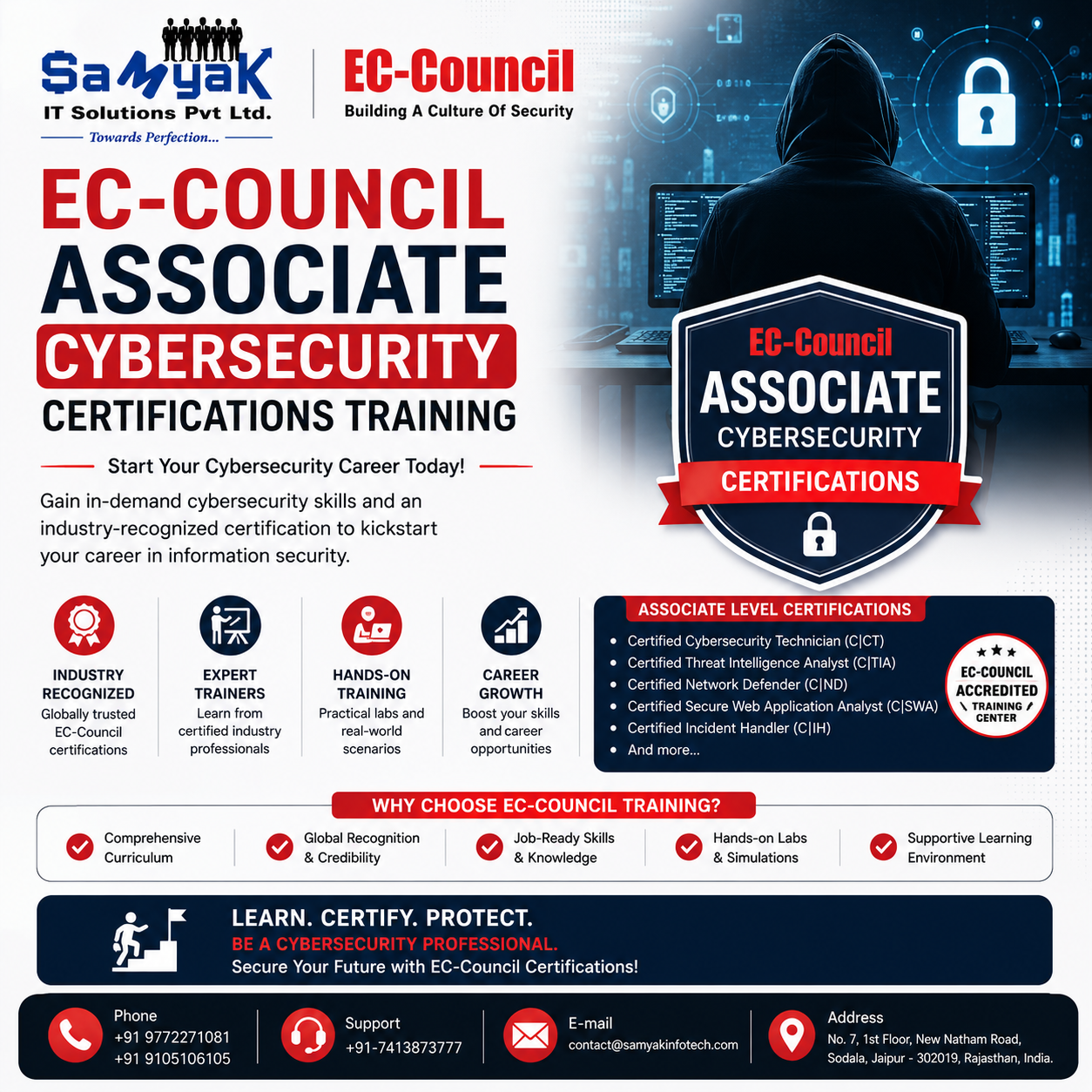
The EC-Council Associate Cybersecurity Certifications Training is one of the most valuable and globally recognized cybersecurity training programs for students and professionals who want to build successful careers in ethical hacking, network security, cybersecurity analysis, digital forensics, and information security management. As businesses, governments, financial institutions, and organizations continue expanding their digital operations, cyber threats and online attacks are increasing rapidly across the world. Because of this growing cybersecurity risk, companies now require skilled cybersecurity professionals who can protect systems, networks, applications, and sensitive data from cyber attacks. This EC-Council Certification course is specially designed to help students gain practical cybersecurity knowledge and become industry-ready security professionals.
The EC-Council Certification course focuses on practical cybersecurity training, ethical hacking concepts, network security, threat analysis, vulnerability assessment, penetration testing, and digital security techniques. Students learn how cyber attacks occur, how hackers exploit system vulnerabilities, and how organizations protect their digital infrastructure using cybersecurity technologies and security management practices.
Cybersecurity has become one of the fastest-growing and highest-paying fields in the IT industry because digital transformation has increased the need for online security and data protection. Every organization now depends heavily on websites, cloud platforms, databases, applications, and digital systems for operations. Without proper cybersecurity protection, businesses face risks such as data theft, ransomware attacks, financial fraud, privacy violations, and system disruptions. This EC-Council Associate Cybersecurity Certifications Training helps students understand modern cyber threats and develop practical security skills required in real industry environments.
One of the biggest advantages of joining the EC-Council Certification course is that EC-Council certifications are globally respected in the cybersecurity industry. Employers recognize EC-Council training because it focuses on practical security knowledge and ethical hacking skills used by professional cybersecurity experts worldwide. Students who complete this training improve their employability and gain strong career opportunities in the cybersecurity sector.
The EC-Council Certification course starts with the fundamentals of cybersecurity and gradually moves toward advanced ethical hacking and security analysis concepts. Students learn network security basics, Linux fundamentals, cyber threat identification, web application security, password security, penetration testing methods, vulnerability scanning, and incident response techniques. The course is designed to help beginners gradually develop technical security expertise and practical hacking knowledge.
Ethical hacking is one of the most important parts of the EC-Council Certification course. Students learn how ethical hackers legally test systems and identify vulnerabilities before malicious attackers exploit them. Ethical hacking helps organizations improve security by finding weaknesses in websites, applications, servers, and networks. Students gain knowledge about penetration testing methodologies and cybersecurity defense mechanisms used in professional environments.
The EC-Council Certification course also focuses heavily on network security and monitoring. Students learn how computer networks communicate, how cyber attacks target networks, and how organizations secure network infrastructure using firewalls, intrusion detection systems, monitoring tools, and security configurations. Network security skills are highly valuable because modern businesses depend on internet-connected systems for operations.
Web application security is another major topic covered in the EC-Council Certification course. Students learn how websites and web applications are tested for vulnerabilities such as SQL injection, cross-site scripting (XSS), authentication flaws, and insecure configurations. Web security testing is extremely important because businesses increasingly rely on web platforms and online services.
The EC-Council Certification course also introduces students to popular cybersecurity tools used by professional security analysts and ethical hackers. Students gain practical experience with Kali Linux, Wireshark, Nmap, Burp Suite, Metasploit Framework, Nessus, and other security tools widely used in penetration testing, vulnerability assessment, and network analysis.
Digital forensics and incident response are additional important areas included in the EC-Council Certification course. Students learn how cybersecurity professionals investigate security incidents, analyze digital evidence, identify attack sources, and respond to cyber threats effectively. Incident response skills are critical because organizations must quickly handle security breaches and minimize damage.
Another major advantage of the EC-Council Certification course is the wide range of career opportunities available after completing the training. Students can work as Cybersecurity Analysts, Ethical Hackers, SOC Analysts, Security Engineers, Threat Intelligence Analysts, Vulnerability Assessment Professionals, IT Security Specialists, and Penetration Testing Associates. Cybersecurity professionals are highly demanded because organizations continuously invest in digital security and cyber defense systems.
The EC-Council Certification course follows a practical learning approach where students work on live security labs, vulnerability scanning exercises, network analysis tasks, penetration testing activities, Linux practice sessions, and ethical hacking simulations. Practical implementation helps students gain hands-on experience and understand real-world cybersecurity operations effectively.
The EC-Council Certification course is also highly beneficial for students preparing for professional cybersecurity certifications and technical interviews. Many companies conduct cybersecurity assessments and practical security evaluations during recruitment. Students who complete this training develop stronger technical confidence and improve their ability to handle professional cybersecurity responsibilities.
Another important benefit of the EC-Council Certification course is the growing global demand for cybersecurity professionals. Organizations worldwide face cybersecurity skill shortages because cyber attacks continue increasing rapidly. This creates strong career opportunities, high salary potential, international job openings, and long-term professional growth in the cybersecurity industry.
The EC-Council Certification course is suitable for beginners, computer science students, networking learners, IT professionals, cybersecurity enthusiasts, graduates, and working professionals interested in ethical hacking and information security careers. Even students without prior cybersecurity experience can learn effectively because the course starts from security fundamentals and gradually moves toward advanced security concepts.
The course also helps students improve analytical thinking, technical troubleshooting, logical reasoning, and security problem-solving abilities. Cybersecurity professionals must analyze threats, identify vulnerabilities, understand attack patterns, and create defense strategies effectively.
Cloud computing, AI systems, IoT devices, remote work environments, and digital transformation are increasing cybersecurity challenges globally. Organizations now require security experts who understand modern cyber threats and can secure digital systems efficiently. Professionals with EC-Council Certification knowledge remain highly valuable in modern technology-driven industries.
Freelancing and consulting opportunities are also available for skilled cybersecurity professionals. Businesses frequently hire ethical hackers and security consultants for penetration testing, website security audits, vulnerability assessments, compliance checks, and cybersecurity guidance. Students who complete the EC-Council Certification course can work independently and build successful cybersecurity consulting careers.
The EC-Council Certification course also supports advanced cybersecurity specialization paths such as penetration testing, cloud security, digital forensics, malware analysis, incident response, and cybersecurity management. This provides excellent long-term growth opportunities for students interested in advanced security careers.
If you are passionate about cybersecurity, ethical hacking, network security, digital protection, information security, or cyber defense technologies, then joining the EC-Council Associate Cybersecurity Certifications Training can be an excellent career decision. The field offers strong job demand, high salary packages, international career opportunities, technical growth, and long-term professional stability.
This EC-Council Associate Cybersecurity Certifications Training is designed to help students become industry-ready cybersecurity professionals by combining practical ethical hacking training, network security concepts, penetration testing techniques, vulnerability assessment methods, cybersecurity monitoring skills, and real-world security experience. Whether your goal is to work in cybersecurity companies, IT security departments, security operations centers, or become an ethical hacking consultant, this course provides the right foundation for long-term success and professional growth in the cybersecurity industry.






 Placement Statistics
 Next Batch:New batches start every month. Limited seats available – enroll early!
 Course Duration:2 Months including Hands-on Practice
 Eligibility:
 Tools:
 Modes of Training:Offline Classroom Sessions (at all Samyak branches) / Instructor-led, Project-based Learning
 Projects:Available